NASCAR 26 Las Vegas Driving Guide
Driving Las Vegas in NASCAR 26 is a test of commitment and tire management. There is braking, there is throttle control, and there is a groove that moves all race long. What there is not is a single fast line you can run all day.
Also See: NASCAR 26 Las Vegas Strategy Guide and NASCAR 26 Cup at Las Vegas Track Guide (Team Conti).
The Basics: Commitment and Tire Care
In Cup cars at Las Vegas, you can run close to full throttle through the turns, but you cannot just hold it flat and hope. The 20-degree banking carries the car through the corners at speed, yet the car will slide as the tires wear. Your steering inputs are small: a little left through the turns, a little right on the straights, and a smooth throttle that keeps the rear tires under you.
Trucks and ARCA cars are slightly different. They have less downforce and less grip, so the draft matters less and car control matters more. In those cars, brake earlier, roll the center, and get the power down cleanly on exit.
The Line: Bottom Early, Top Late
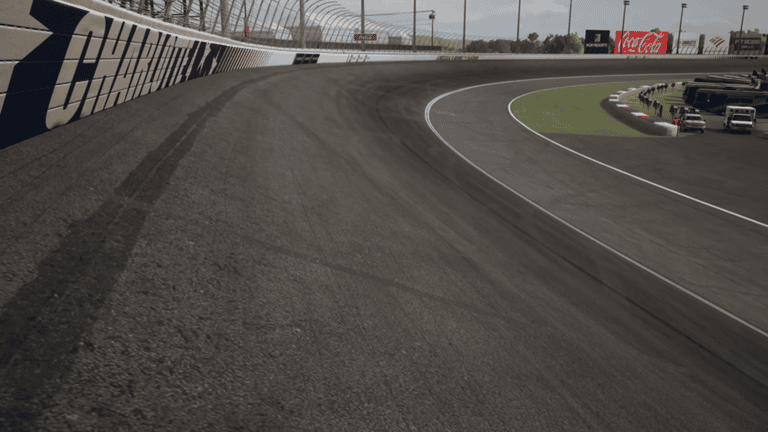
Las Vegas has a fast line, but it moves. On fresh tires, the bottom lane is quickest: shortest distance, most grip. As the tires fade, the bottom loses grip first and the top lane comes in. The fastest drivers read the track every few laps and move their line to where the grip is.
Enter low, let the banking carry the car, and let it drift up on exit. Fight the car back to the bottom and you will scrub speed. Trust the banking and the car will find its own way out.
Lane Choice
The tri-oval gives you three lanes, and each has a personality.
Bottom lane: Shortest distance, most grip early in a run. Good for qualifying laps and for defending on restarts.
Middle lane: The compromise. Often the fastest line when the bottom gets slick and the top has not come in yet.
Top lane: Longest way around, but the momentum lane late in a run. If the car is loose on the bottom, the top is where the speed is.
The fast line changes with the tires. Watch where the leaders run and follow, but be ready to go where the grip is, not where everyone else is.
Restarts
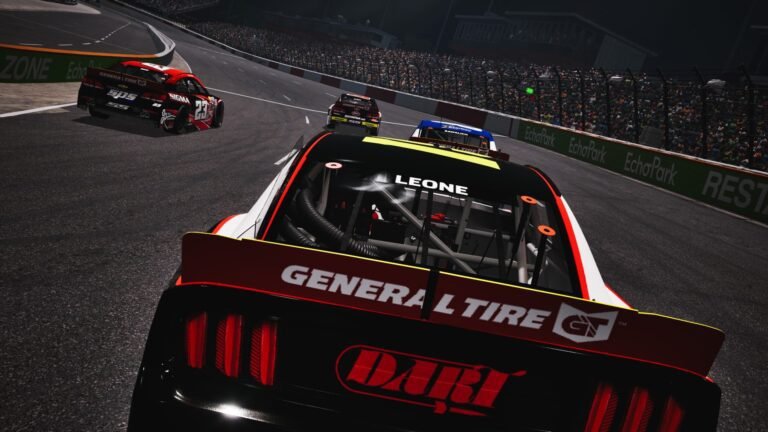
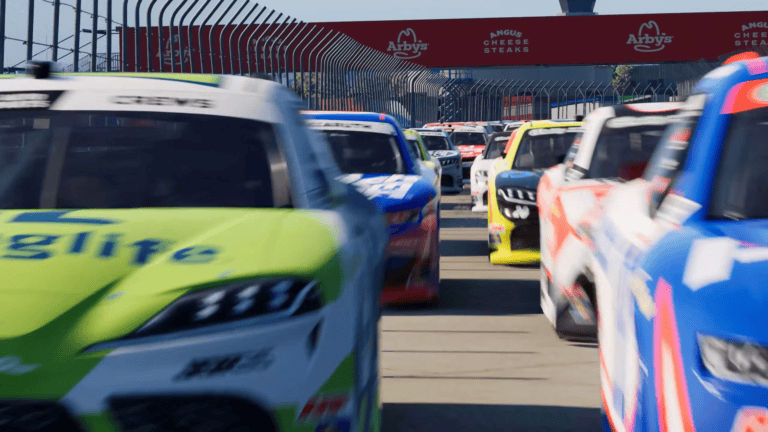
Restarts at Las Vegas are about momentum. The field bunches up, everyone wants the bottom into Turn 1, and the cars that get a clean exit off Turn 2 will carry the run down the backstretch.
Your job on a restart: pick a lane early, commit to it, and find the grip. Do not swerve between lanes looking for a better one. The car that commits first is usually the car that leads into Turn 3.
Avoiding the Wall
You cannot avoid every mistake at Las Vegas, but you can avoid most of them.
- Respect the bump in Turn 2. It will unsettle a car that is already loose, so be straight and smooth through it.
- Watch ahead, not just the bumper in front of you. If you see smoke or a car turning sideways three cars up, lift early.
- Have an escape plan. Always know which way you will go if the car ahead checks up: inside or outside.
- Do not overcorrect. When the car gets loose on exit, small corrections. Big steering inputs make a loose car worse.
Practice Drill
Run 20 laps in practice with one goal: keep your lap times within a few tenths from lap 5 to lap 20. If your times fall off a cliff, you are using the tires too hard. Slow your hands down, brake a little earlier, and roll more speed through the center. The fastest lap at Las Vegas is rarely the one where you tried hardest.