NASCAR 25 Setups: Complete Tuning and Garage Guide
NASCAR 25 setups can be as simple as moving one slider or as detailed as changing springs, shocks, tire pressures, camber, sway bars, weight distribution, and gearing. The trick is not changing everything at once. A fast setup starts with identifying what the car is doing, deciding where in the corner the problem happens, and making one adjustment you can actually evaluate.
Also see:
► Our NASCAR 25 setups from Team Conti overview
► NASCAR: Steve Letarte explains the NASCAR 25 garage
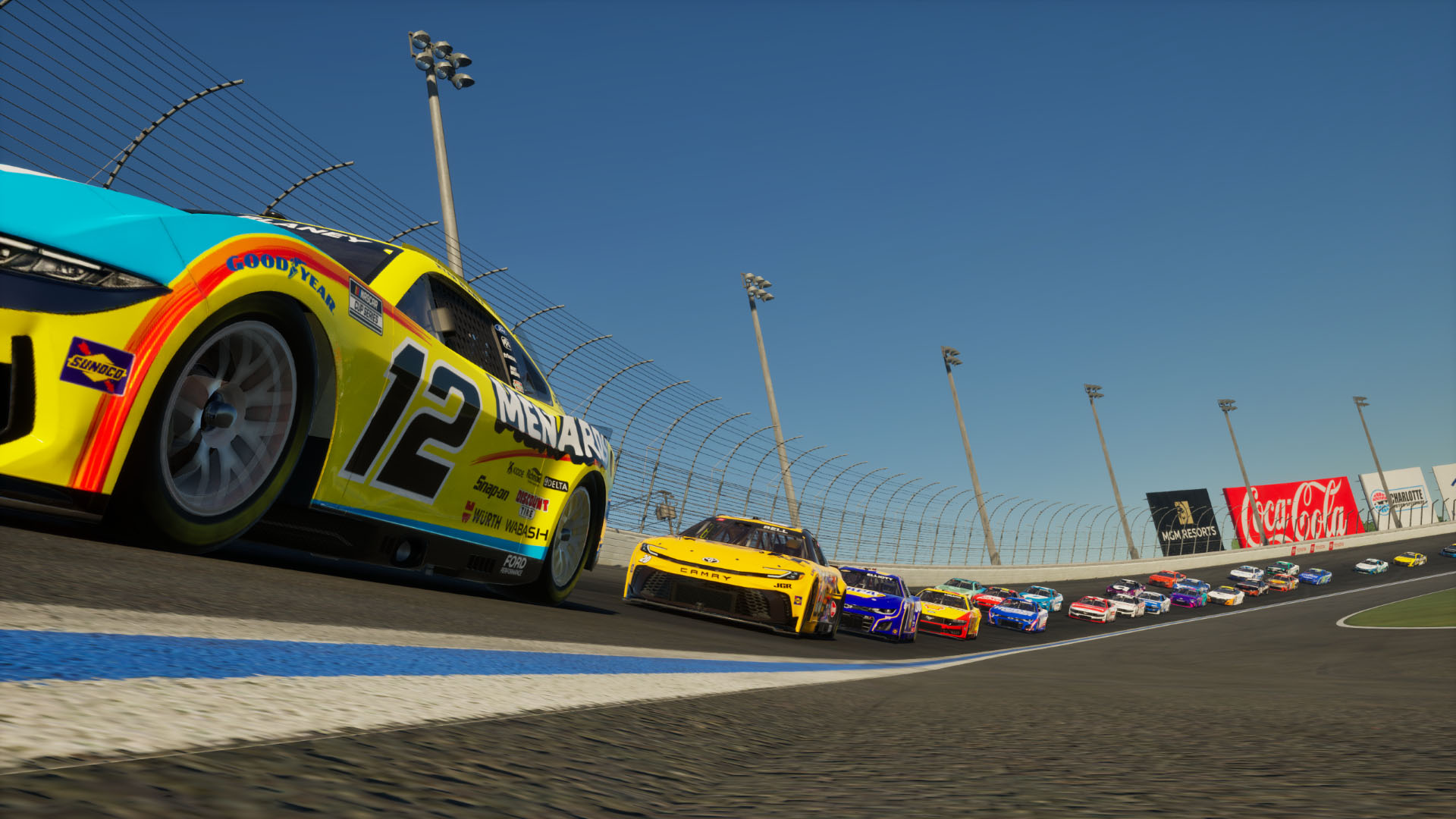
Every car comes with a base setup. For many players, that base is intentionally safe and slightly tight. That makes the car easier to control, but it can also make it reluctant to turn. NASCAR analyst and former crew chief Steve Letarte recommends trying the simple slider about 25 percent toward loose as an early test, especially at Martinsville. That is a starting point, not a magic number for every track.
Start With Tight Versus Loose
A tight car does not rotate enough. You turn the wheel, but the front tires slide and the car pushes toward the outside wall. The problem can appear while braking, in the center of the corner, or when you return to the throttle.
A loose car rotates too much. The rear tires lose grip, so the back of the car tries to come around. Loose handling can also happen at different phases of the corner. A car that feels secure on entry can still snap loose when you accelerate.
Those two words describe balance, not the full diagnosis. Before changing the setup, ask three questions: Is the car tight or loose? Does it happen on entry, in the center, or on exit? Does it appear immediately or only after the tires build heat?
Preset Slider or Custom Setup?
NASCAR 25 gives players two ways to tune. The preset tight-to-loose slider changes the car’s overall balance without forcing you to understand every garage page. It is the right tool when you need a small correction or are still learning how the car communicates.
Move toward loose when the car refuses to rotate. Move toward tight when the rear feels nervous or steps out. Make a modest change, run several clean laps, and compare the result. Do not jump from one end of the slider to the other unless the base setup is completely wrong for your driving style.
The custom garage is for players who want to target a specific part of the corner. It separates adjustments by tire and also provides global settings for the entire car. That extra control is powerful, but only when you know what problem you are trying to solve.

What the Corner Adjustments Do
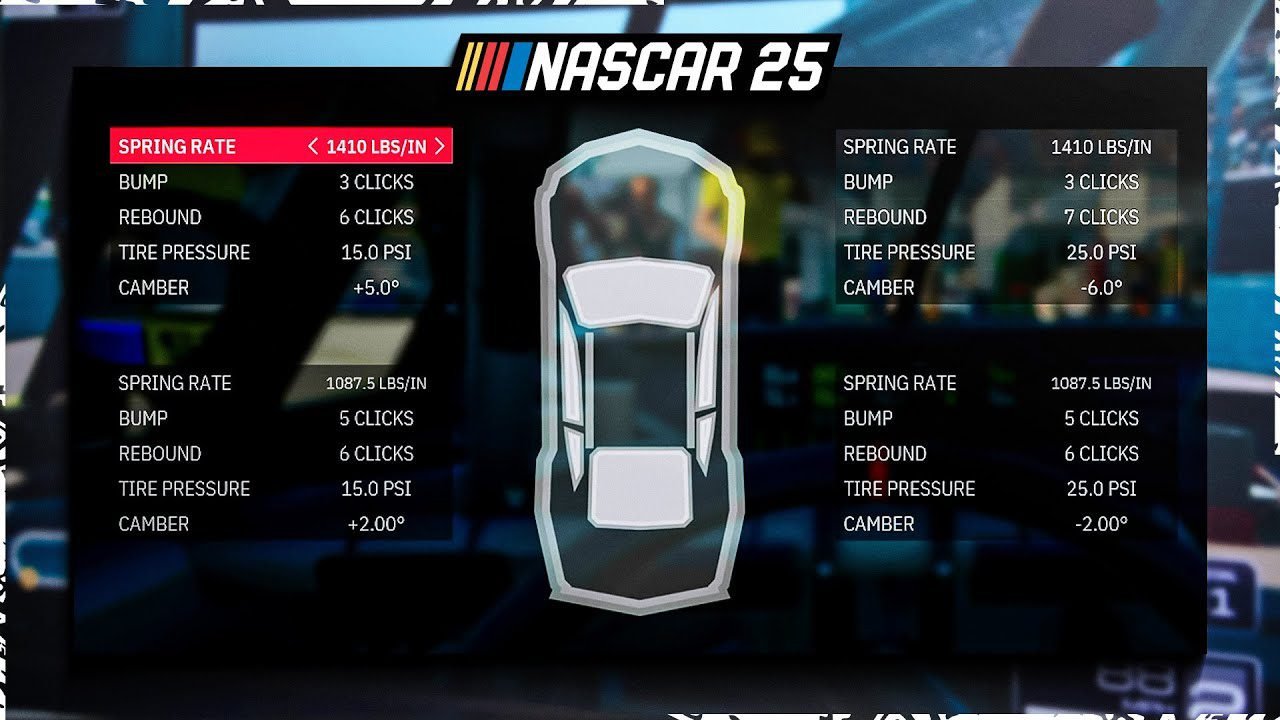
Each corner of the car includes spring rate, shock bump, shock rebound, tire pressure, and camber. The same setting can affect the car differently depending on whether it is on the front, rear, left, or right.
Spring rate controls how resistant that corner is to compression. A softer right-front spring can help a tight car turn through entry and the center. However, a spring change also affects the platform and how weight travels across the car.
Shock bump controls resistance while the shock compresses. Shock rebound controls resistance as the shock extends. Letarte uses front rebound as an example for a car that is loose on exit. Reducing rebound can let the front rise more freely, transfer weight rearward, and give the rear tires more help when the driver accelerates.
Tire pressure changes the tire’s response, temperature, and contact with the track. A beginner can think of lower pressure as a way to seek more grip at that tire, but the full effect is more complicated. Pressure changes should be checked over a longer run because heat can turn an early improvement into a late-run problem.
Camber tilts the tire relative to the track. The goal is to keep the loaded portion of the tire working efficiently in the corner. More camber is not automatically better. An aggressive setting may feel strong for a lap and then overwork the tire as the run continues.
What the Global Adjustments Do
The front sway bar controls how much the front of the car resists roll. A smaller front bar generally helps the car rotate. A stiffer front bar generally makes the car tighter and more resistant to direction changes.
The rear sway bar works from the other end. A larger rear bar can help the car change direction, but it also frees the rear and can make the car looser. A smaller rear bar adds security. NASCAR 25 allows the rear bar to be removed on some combinations, although that can make the car very tight.
Wheel lock controls how far the front tires turn. If steering feels too slow or you cannot get enough angle at a tight track, more wheel lock can help. It is not a substitute for fixing a balance problem, though. A tight car with more steering angle is still a tight car.
Brake bias controls how much braking force goes to the front. Values above 50 percent favor the front brakes. Letarte describes the mid-to-upper 50s as a common range. If the rear tries to rotate under braking, moving the bias forward can make entry more secure. Too much front bias can make the car reluctant to rotate.
Rear-end ratio determines engine speed down the straightaway. The goal is to use the engine’s power without hitting the limiter too early. Gearing must match the track, series, and whether the car is running alone or in a draft.
Wedge, Left-Side Weight, and Nose Weight
Wedge, also called cross weight, is the combined weight carried by the right-front and left-rear corners. Adding wedge generally tightens the car and improves rear security under power. Removing wedge generally helps rotation, but too little can make the rear tires spin on exit.
Left-side weight is straightforward on an oval. NASCAR 25 limits it to 53 percent, matching the rule Letarte references in the official video. Because an oval car turns left, he recommends maximizing left-side weight. A road-course setup needs a more balanced starting point because the car must turn in both directions.
Nose weight describes how much total weight sits on the front tires. More nose weight generally makes entry feel secure and tight. Less can help the car change direction, but it may also make entry less comfortable. That is the constant setup compromise: the change that fixes one phase can create a new problem somewhere else.
Trim in the NASCAR 25 garage is not an aerodynamic trim setting. It helps the car track straight down the straightaway. Use it to center the steering and reduce the need to hold unnecessary wheel input in a straight line.
Diagnose Your NASCAR 25 Setups Before Making a Change
If the car is tight on entry or in the center, start with the front because those tires are carrying much of the load. The right-front is often the first place to investigate on an oval. A small reduction in right-front spring rate or front sway-bar stiffness may help rotation.
If the car is loose under braking, look at brake bias before tearing apart the suspension. If it is loose on exit, think about rear grip and weight transfer. Wedge, front shock rebound, and the rear sway bar can all influence that phase.
If the car gets worse after several laps, review tire pressure and camber. A qualifying setup only needs to be excellent briefly. A race setup must remain predictable as the tires heat and wear.
Build NASCAR 25 Setups One Change at a Time
Run the default setup first. Complete enough clean laps to establish a repeatable baseline, including an average time rather than only one lucky lap. Write down what the car does on entry, in the center, and on exit.
Next, make one small change. Return to the track under similar conditions and run the same test. Keep the change if both the stopwatch and the handling improve. Revert it if the car only feels more exciting while becoming slower or less consistent.
Save separate versions for qualifying and racing. A qualifying setup can trade stability and tire life for immediate speed. A race setup needs to work in traffic and remain manageable across a longer run.
Controller sensitivity, driving assists, and stability settings also change how a setup feels. That is why a setup copied from another player may not behave the same way for you. Use shared builds as baselines, then tune them around your inputs and comfort level.
Oval and Road-Course Setups Need Different Thinking
An oval setup can use asymmetric weight and alignment because the car spends the lap turning left. That is why maximum left-side weight is such a common baseline.
A road-course car has to brake heavily and turn both directions. Left-side weight should move closer to 50 percent, and the setup cannot be optimized for one loaded side through every corner. Braking stability, direction changes, and traction out of slow turns become more important.
Track type matters too. Martinsville asks the car to stop, rotate, and launch from slow corners. Daytona rewards straight-line efficiency and stability in traffic. A setup principle can carry from one track to another, but the final values rarely should.
The Best NASCAR 25 Setups Are the Ones You Can Repeat
A setup is not fast because its garage numbers look aggressive. It is fast because the driver can place the car correctly, protect the tires, and repeat the lap without fighting the wheel.
Use the simple slider when it solves the problem. Open the custom garage when you can describe exactly what the car needs. Most importantly, test each decision instead of stacking changes and hoping the stopwatch agrees.
That process will not produce a perfect setup in five minutes. However, it will teach you why the car behaves the way it does. Once that starts making sense, NASCAR 25 setups stop looking like a wall of numbers and start becoming useful tools.